
PRS Database: What Landlords Must Do Before 15 December 2026 (and Why It Changes Tenant Referencing)
England’s national landlord register opens on 15 December 2026. From that date, every private landlord in England will be called forward, region by region, to register themselves and each property they let, at £65 per property per year.
Phase 1 of the Renters’ Rights Act changed how tenancies work. Phase 2 changes who is allowed to rely on them. Once your region’s deadline passes, an unregistered landlord can’t legally market a property and, in most cases, can’t get a possession order. With Section 21 already gone, that turns registration from admin into a condition of being able to manage risk at all.
This guide covers the dates, the cost, what you’ll be asked for, what happens if you miss it, and why it makes choosing the right tenant more important than ever.
What is the PRS Database?
The Private Rented Sector (PRS) Database is a national register of landlords and rented homes in England, created by the Renters’ Rights Act 2025. The government service you’ll actually use is called Register your rental property.
It applies to landlords of assured and regulated tenancies, which covers almost every private let since 1 May 2026. That includes long-standing tenancies: there’s no exemption for a tenant who has been in place for years.
Registration happens in two parts:
- Register yourself as a landlord. You’ll receive a Landlord Registration Number. Joint owners each register separately, and limited companies register as the company.
- Register each property. You’ll receive a Property Registration Number for each one.
For each property, expect to provide the address, ownership type, property type, number of bedrooms, number of occupants and households, the rent and how often it’s paid, whether bills are included, licensing and HMO status, and your current gas safety, electrical (EICR) and EPC information.
Once registered, entries must be kept up to date. Under the draft regulations, changes such as a new tenant, a rent increase or a renewed certificate must be updated within 28 days. Each entry is renewed annually.
The register covers England only. Scotland, Wales and Northern Ireland already run their own landlord registration schemes.
When do you need to register? Dates by region
The service opens one region a month, starting with the West Midlands on 15 December 2026. Each region then has three months to register, and every let property in England must be registered by 14 November 2027.
| Region | Registration opens | Deadline |
|---|---|---|
| West Midlands | 15 December 2026 | 14 March 2027 |
| East of England | 15 January 2027 | 14 April 2027 |
| East Midlands | 15 February 2027 | 14 May 2027 |
| South East | 15 March 2027 | 14 June 2027 |
| Yorkshire and the Humber | 15 April 2027 | 14 July 2027 |
| North West | 15 May 2027 | 14 August 2027 |
| North East | 15 June 2027 | 14 September 2027 |
| London | 15 July 2027 | 14 October 2027 |
| South West | 15 August 2027 | 14 November 2027 |
Two points catch landlords out:
- Your region is set by where the property is, not where you live. A landlord in Swindon with a flat in Birmingham is on the West Midlands timetable for that flat.
- You don’t have to wait. Once the service goes live on 15 December, properties in any region can be registered early. If you let across several regions, registering everything in one go saves tracking up to nine separate windows.
How much does it cost?
The fee is £65 per property, per year. It is charged for each dwelling, not once per landlord, and it renews annually. There’s no charge to register yourself as a landlord.
The government says the fee will be pro-rated during the rollout, so registering early shouldn’t cost you more than registering late. The draft regulations don’t fix the amount permanently, so budget for it to rise over time.
You can’t pass the fee on to your tenant as a charge. It isn’t a permitted payment under the Tenant Fees Act 2019. It should, however, normally be treated as an allowable expense of your letting business. Check the treatment with your accountant.
How the fee applies to HMOs let by the room, or buildings split into several flats, hasn’t been fully confirmed yet. If that’s you, list your units and tenancy arrangements now so you can price it quickly once detailed guidance lands.
Can your letting agent register for you?
No. Landlords must start and complete registration themselves and pay the fee, even if an agent fully manages the property. Agents will be able to supply some information on a landlord’s behalf, with further government guidance promised before launch, but the legal duty stays with the landlord.
What happens if you don’t register?
The fines get the headlines, but losing access to possession is the bigger risk.
Breach | Consequence |
Letting or marketing a property without registering | Council civil penalty of up to £7,000 |
False or misleading information, or repeat or continuing breaches | Civil penalty of up to £40,000, or prosecution |
Continuing to fail to register after a penalty | A rent repayment order can follow |
Seeking possession while unregistered | Court can’t grant possession, except on the anti-social behaviour grounds (7A and 14) |
That last row matters most. Since 1 May 2026, Section 8 grounds are the only route to possession in England. If you’re in breach of the duty to register, the court can’t make a possession order on rent arrears, on selling, or on moving back in until you’ve put it right.
Not being able to advertise is the other practical trap. If a tenancy ends and you’re not registered, the property can’t be legally marketed, and every week of delay is a week of lost rent.
Why the register raises the stakes on tenant referencing
The PRS Database and tenant referencing protect you at opposite ends of a tenancy. Registration keeps your legal remedies available if something goes wrong. Referencing reduces the chance you’ll ever need them.
Look at how the landlord’s toolkit has changed in 18 months:
- Section 21 has gone. Ending a tenancy now needs a specific Section 8 ground and a court process.
- Rent in advance is capped at one month. Taking six months upfront to cover a marginal applicant is no longer an option.
- From December, possession depends on registration too. Even a valid Section 8 claim stalls if your entry is missing or out of date.
Each change makes a bad tenancy slower and more expensive to unwind. That moves the real decision point to the start: the tenant you accept is, increasingly, the tenant you keep.
Good referencing at that stage means:
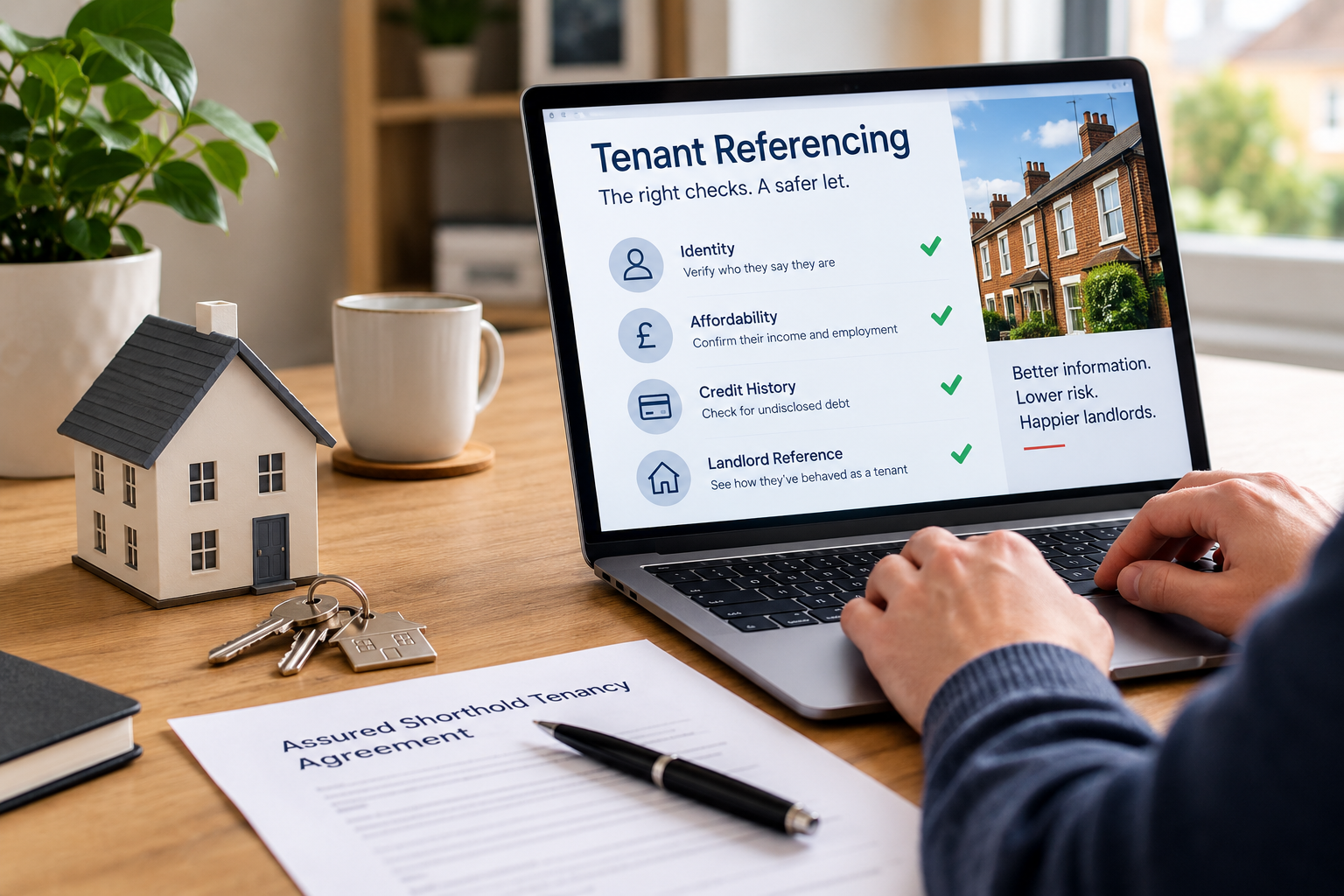
- Verified income and affordability, not just a credit score. A credit check confirms identity and history but says nothing about whether the rent is affordable.
- A previous landlord reference that confirms how the applicant actually behaved as a tenant.
- Consistent, documented decisions. Since 1 May 2026, you can’t refuse applicants because they have children or receive benefits. Basing every decision on verified affordability, applied the same way to everyone, protects you if a decision is ever questioned.
- A fallback for marginal applicants. With rent in advance capped, a properly referenced guarantor or rent protection now does that job.
Our Full Tenant Profile combines credit, income, employment and landlord references, with every application reviewed by a real case manager rather than an algorithm, and the Guarantor Suitability Check makes sure your safety net will actually hold.
What tenants will see, and what comes next
The government says tenants will eventually be able to use the service to check whether a landlord meets key legal requirements before signing. Exactly what will be visible to tenants and the public hasn’t been decided, and no date has been set for public access.
Later, written property adverts will need to show both the landlord and property registration numbers. That requirement switches on under future legislation, with guidance first.
The next major step after the database is the PRS Landlord Ombudsman, expected in 2028. It will give tenants a free route to raise complaints, and membership will be mandatory for landlords.
Frequently asked questions
- When does the PRS Database open?
On 15 December 2026, starting with the West Midlands. One new region opens each month until the South West on 15 August 2027.
- How much does it cost to register a rental property?
£65 per property, per year. There's no charge to register yourself as a landlord.
- Do I need to register if my tenant has lived there for years?
Yes. The duty covers existing assured and regulated tenancies, not just new ones.
- Do I need to register an empty property?
Not in the first phase. Future legislation is expected to require registration before an empty property is marketed for let.
- Do I need to register a lodger?
Not if they're a genuine lodger in the home you live in. If you don't live in the property, room lets are normally assured tenancies and must be registered.
- Can my letting agent register for me?
No. You must start and complete the registration yourself, although your agent will be able to supply some information.
- What if I miss my deadline?
You risk a council penalty of up to £7,000. While you're unregistered, you also can't legally market the property, and most possession
- Does registration replace selective or HMO licensing?
No. Licensing remains a separate duty with its own fees and renewal dates.
- Does the register apply in Wales or Scotland?
Does the register apply in Wales or Scotland? No. It covers England only. Wales has Rent Smart Wales and Scotland has the Scottish Landlord Register.