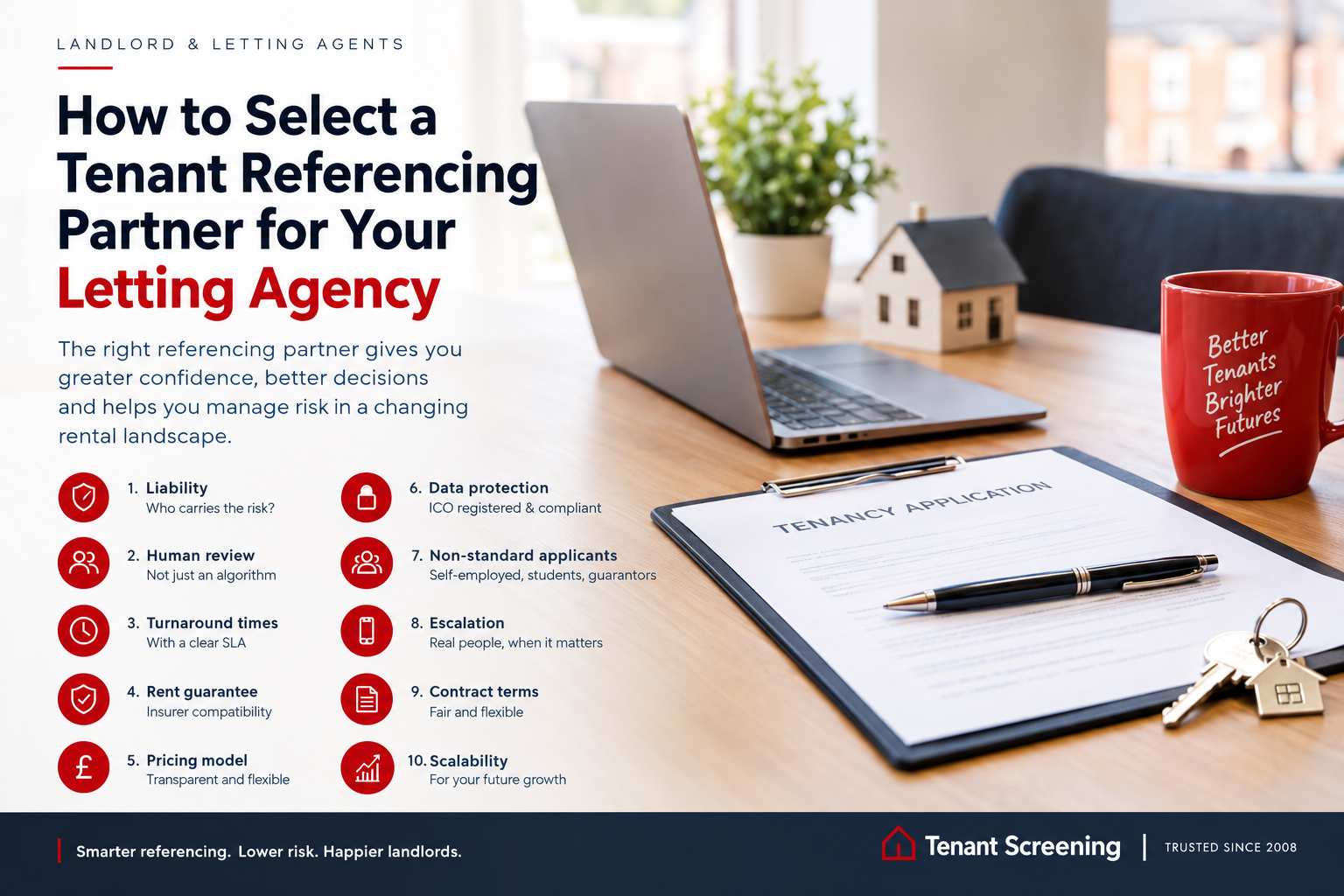

How to Select a Tenant Referencing Partner for Your Letting Agency
Short answer: A letting agency should select a tenant referencing partner on ten criteria: who carries the liability for a wrong decision, whether reports are reviewed by a named case manager, turnaround times backed by a service level agreement, rent guarantee insurance compatibility, pricing model, data protection position, handling of non-standard applicants, escalation routes, contract terms, and portfolio scalability. Since the Renters’ Rights Act removed Section 21, the referencing decision is now the main point at which tenancy risk can be controlled, so supplier choice carries more weight than it did before May 2026.
Why this decision changed on 1 May 2026
The Renters’ Rights Act 2025 received Royal Assent on 27 October 2025, and its first phase commenced on 1 May 2026 in England. Three changes matter directly to referencing.
- Section 21 is abolished. Assured shorthold tenancies converted to periodic assured tenancies. An agency can no longer quietly correct a poor letting decision at the end of a fixed term.
- Rent in advance is capped at one month. The common workaround for an applicant who failed affordability has gone.
- Discrimination provisions apply. Refusing applicants because they receive benefits or have children is unlawful. Any referencing process that screens these applicants out, whether by policy or by scoring model, exposes the agency.
The practical consequence is that a marginal applicant now has to be resolved at referencing stage, through a guarantor, rent protection, or a documented affordability decision. A supplier that returns a bare pass or fail leaves the agency to do that work.
The ten criteria
1. Who carries liability. Ask whether the provider stands behind its recommendation and what happens if a reference is wrong. Ask to see professional indemnity cover.
2. Human review or algorithm. Fully automated screening is fast and cheap, and it produces false negatives on self-employed applicants, contractors, recent arrivals and benefit recipients. Ask whether a person reviews the file before the recommendation is issued, and whether you can speak to that person.
3. Turnaround, with an SLA. Distinguish the instant element from the full reference. An identity and credit check can return in about an hour. A full reference depends on employers and previous landlords replying, so two working days is a realistic benchmark. Ask who chases referees, and how often.
4. Rent guarantee compatibility. If you sell rent protection, confirm that the insurer accepts this provider’s references. A reference that does not satisfy the policy conditions is worthless at claim stage.
5. Pricing model. Compare pay-as-you-go against minimum volumes, credit bundles, monthly platform fees and setup charges. Bundles and minimums transfer the cost of your void periods onto you.
6. Data protection. Check the ICO registration number on the register. Ask where applicant data is processed, how long it is retained, and request the data processing agreement before you sign anything.
7. Non-standard applicants. Ask specifically how the provider handles self-employed applicants, company lets, students, guarantors, and applicants with no UK credit file. These are where automated systems fail and where your negotiator loses a let.
8. Escalation. When a report is ambiguous or you what to check something can you phone someone who has seen the file?
9. Contract terms. Notice periods, exclusivity clauses, tie-ins and volume commitments.
10. Scalability. Dashboard access for multiple branches, per-negotiator logins, document storage, and audit trail.
A supplier comparison you can run in an afternoon
|
Question to ask |
What a strong answer sounds like |
|---|---|
|
Who reviews the report? |
A named case manager, before issue |
|
What is the full reference SLA? |
A stated number of working days, with chasing built in |
|
What is your credit data source? |
A named credit reference agency |
|
What does it cost to start? |
Nothing. Pay per check |
|
Can I speak to someone about a specific file? |
Yes, directly |
|
Are your references accepted for rent guarantee? |
Yes, with the insurer named |
How Tenant Screening answers those questions
Tenant Screening Ltd has provided referencing to UK letting agents and landlords since 2008 and has processed over 90,000 online applications. Every report is reviewed by a case manager before a suitability recommendation is issued. Credit data is supplied through a partnership with Equifax, which surfaces undisclosed debt linked to the applicant’s current and recent addresses. Bank details supplied by the applicant are validated as genuine accounts. Pricing is pay-as-you-go from £10.95 per check with no setup charge, no monthly fee and no credit bundles. The company is registered with the ICO under number ZA775957 and is based at 3-5 Wood Street, Swindon SN1 4AN.
Next step: Book a demo or call 01793 847014.
Frequently asked questions
- What should a letting agency look for in a referencing provider?
Liability position, human review of reports, a stated turnaround SLA, rent guarantee compatibility, transparent pay-as-you-go pricing, ICO registration, and a documented process for self-employed, overseas and guarantor applicants.
- Can a letting agent charge the tenant for referencing?
No. Referencing fees charged to a tenant are a prohibited payment under the Tenant Fees Act 2019 in England, with equivalent bans in Wales and Scotland. The landlord or agent pays.
- How long should agency referencing take?
An identity and credit check can return within an hour. A full reference including income verification and a landlord reference typically takes several working days, because it depends on third parties replying.
- Do I need a contract with a referencing provider?
Not necessarily. Some providers require volume commitments or monthly fees. Others, including Tenant Screening, operate pay-as-you-go with no tie-in.